

A widely used quote, apparently originally written in the New York Times, is:
“If Kent is the garden of England, Dungeness is the back gate.”
I’ve been reflecting on a trip I made to Dungeness earlier in the summer as part of a Kent road trip with my son.
This is a remarkable place, and most unlike anywhere else in the UK.
It’s a landform called a cuspate (‘tooth shaped’) foreland which has accreted over many years in a series of ridges, which were visible from the top of the Old Lighthouse which I climbed. I thought that it could make a great case study for ecosystems in geography, or the new GCSE Natural History1 Here is the first draft of some thoughts in that area.
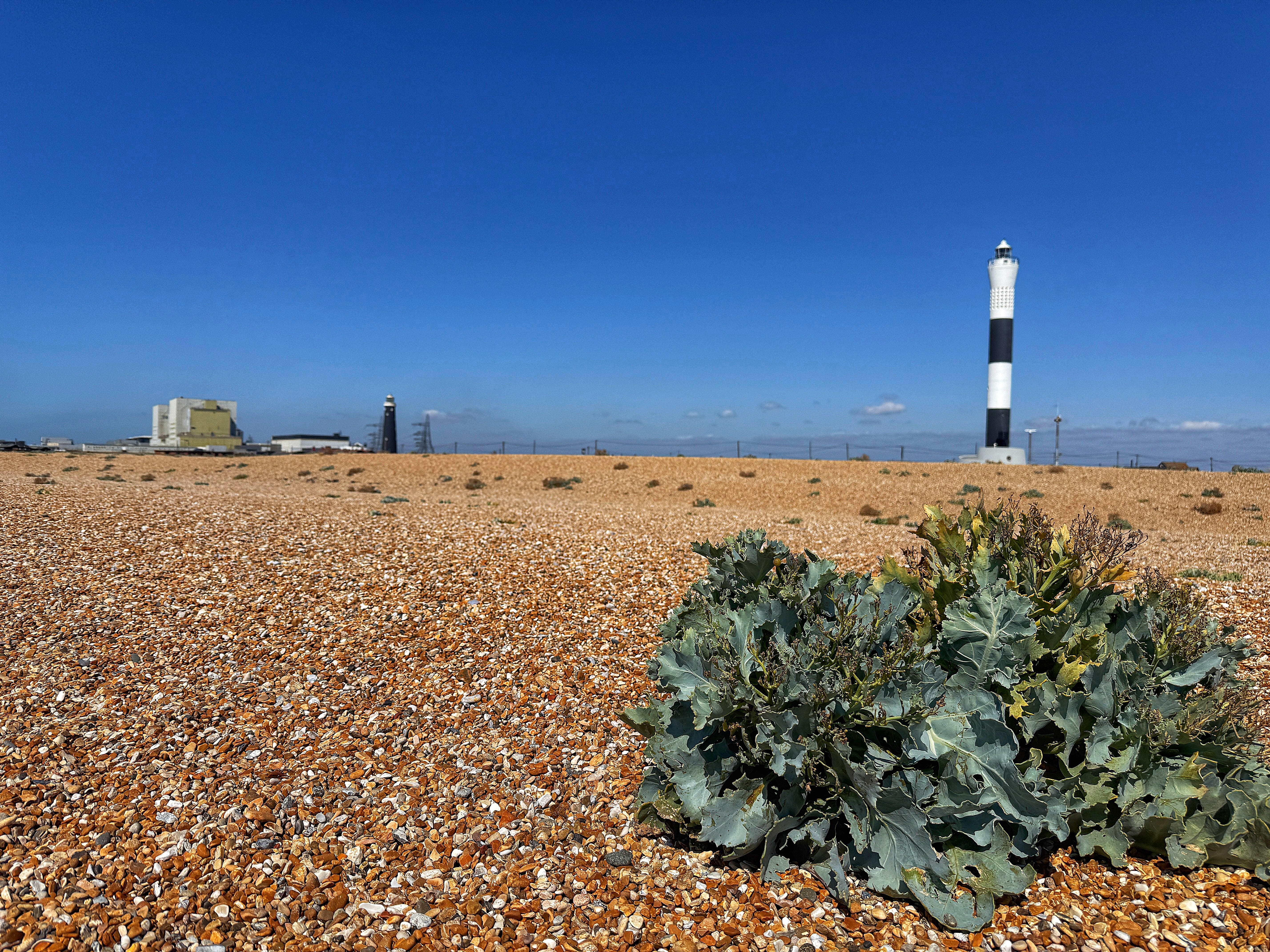
Image: Sea Kale and the new lighthouse, Dungeness, Kent - Alan Parkinson
Dungeness is one of the largest expanses of shingle in Europe, and is home to a huge range of plants - many of which are adapted to the particular ecosystem and microclimate that has developed. Dungeness sits on the south coast of Kent, with Camber and Camber Sands just to the west, and forms the southern most part of Romney Marsh. Ashford lies to the north. Folkestone and Dover lie to the North East, and the famous White Cliffs can be viewed from across the headland. To the south lies the English Channel. It has frequently been described2 as “Britain’s only desert'“ but it isn’t one. It sits on the flightpath for many flights out of the UK towards southern Europe, and I have flown over it several times. Its shape is identifiable from the air.
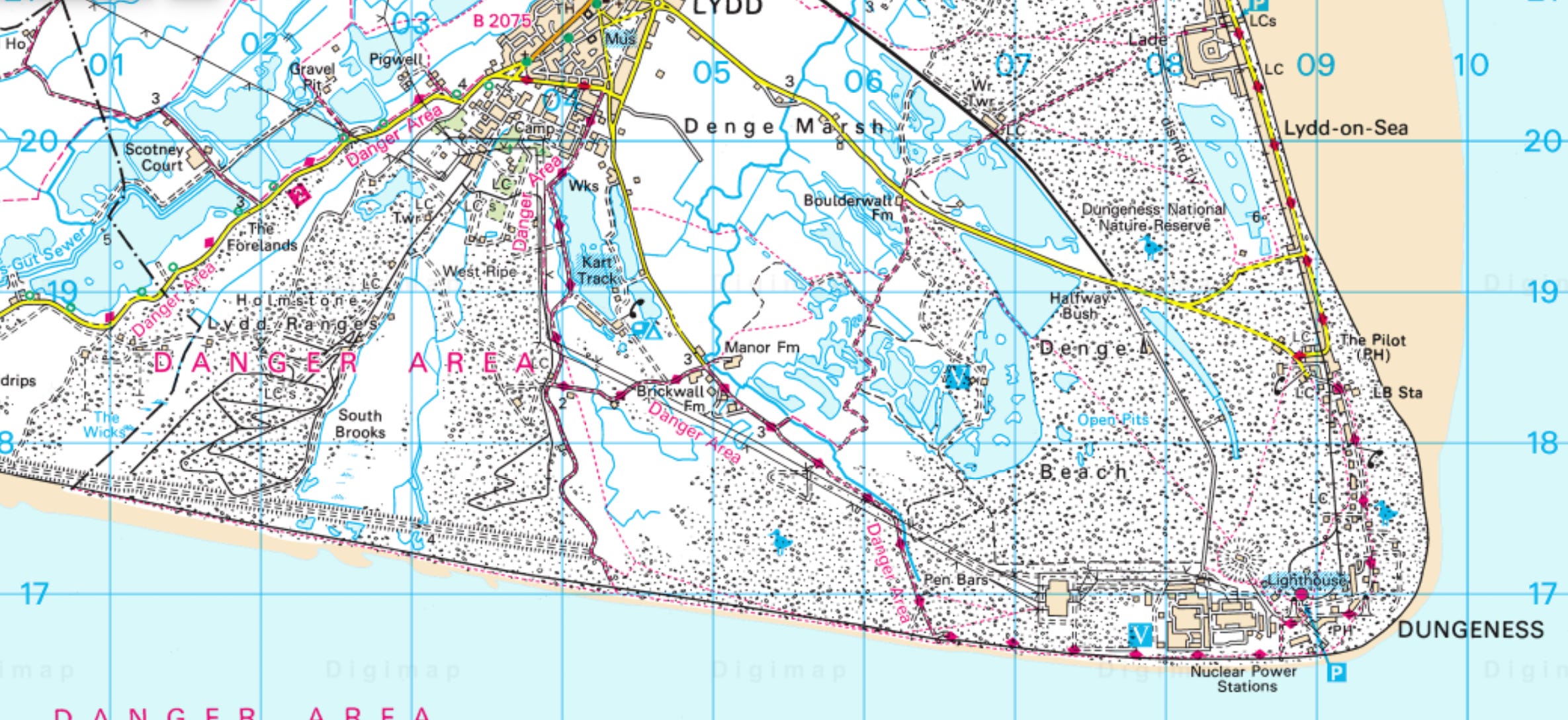
Source: Digimap for Schools / EDINA / Ordnance Survey
The Romans created sea defences, at Dymchurch and the Rhee Wall, which stretches from Appledore to Romney to help stabilise the feature. EU funding has since helped finance a multi-million pound sea wall at Dymchurch and beyond, because the whole feature is very low-lying. The shingle is pushed along from the north, and the west, and built out.
The road onto the Dungeness Estate is a dead end - serving the former nuclear power stations.
Physical features
Dungeness consists of over 500 gravel beaches, made largely from ice age flints, which have accumulated since the mid-Holocene period. The gravel areas are interspersed with marsh sediment. This contrast and the curving features can be seen in the image below.
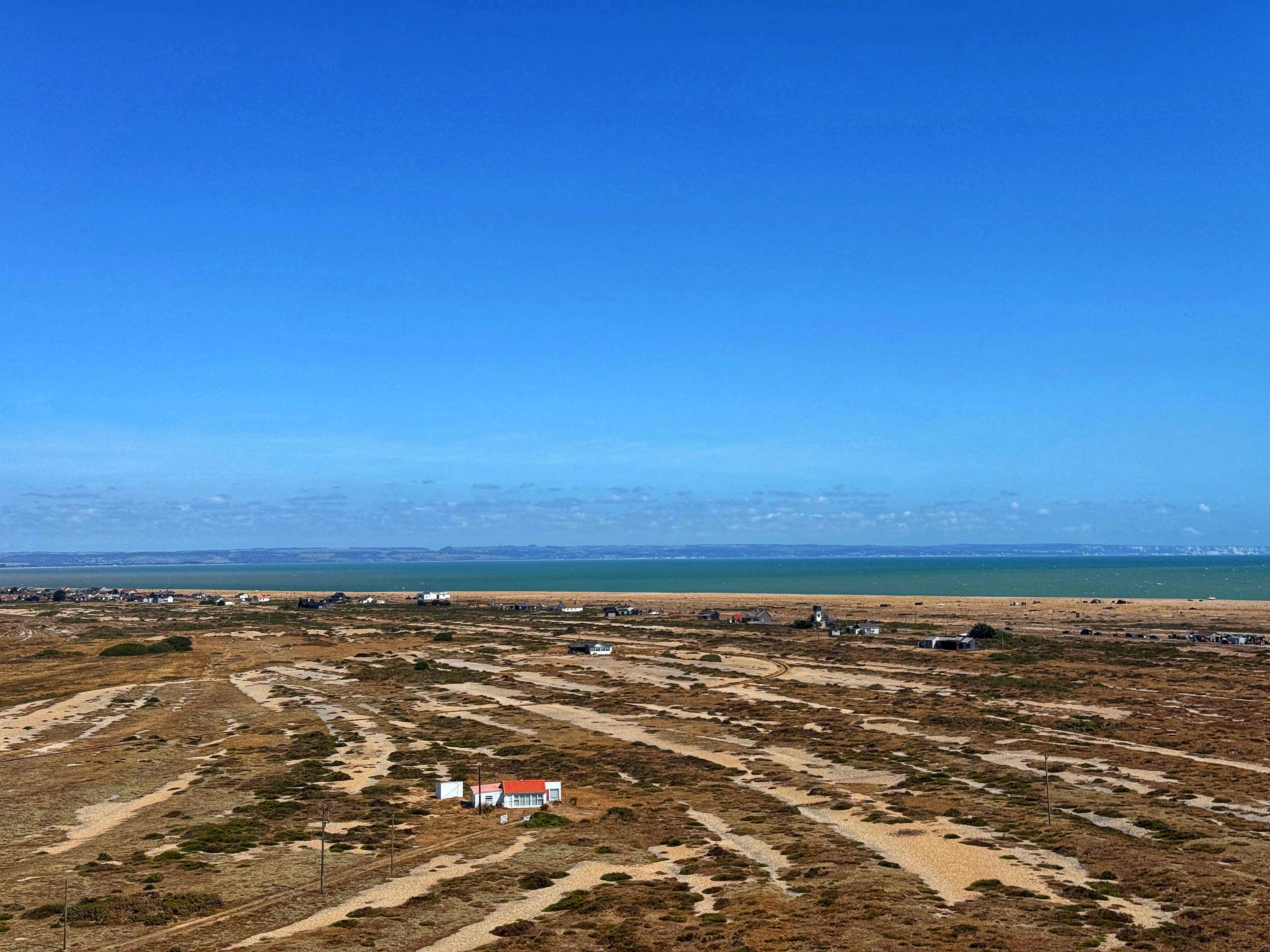
Image: View from the top of the Old Lighthouse - Alan Parkinson
Shingle ridges are found across Dungeness. There are also shingle beaches that shelve steeply down. These are popular with sea anglers and littered with remnants of crabs.
Common and grey seals can often be seen offshore along with harbour porpoise and dolphins at times.
Natural History: flora and fauna
“Dungeness, a strange land of extremes, one of the most valuable and yet vulnerable nature conservation sites in Great Britain”
Firth, 1984
Dungeness is a National Nature Reserve3 It is home to 600 species of plants which is a third of all plants found in the UK. Many plants found on Dungeness are those that thrive amongst the salty pebbles with little or no soil and seed freely such as sea kale, Viper’s bugloss, and the everlasting sweet pea. Any soil is thin and lacking in nutrients and also has high salt levels, meaning halophytic plants can thrive here. The area is also a Site of Special Scientific Interest (SSSI) and a Ramsar site (a wetland of international importance). The Ramsar designation says:
Dungeness and Rye Harbour comprise the largest cuspate foreland (a low-lying triangular foreland) in Britain and form part of a system of shingle barrier beaches that can be traced 40 km from Fairlight in East Sussex to Hythe in Kent. This is ideal habitat for annual vegetation of drift lines, which occurs on naturally functioning shingle beaches. It is one of the scarcest habitats in the UK.

The area also has an RPSB reserve.4 Kent Wildlife Trust also operates in the area.5
The RSPB’s description of the area identifies some key species which live here, or visit at certain times of year.
The Dungeness reserve is set back from the sea, boasting mile after mile of open shingle, freshwater pits, wet grassland and stunning wildflower meadows. We look after the reserve’s wet and dry grasslands to create good breeding conditions for Lapwings, Redshanks and Garganeys, as well as two uncommon bumblebee species – the Brown-banded Carder Bee and Red-shanked Carder Bee.
Watch the sky in spring and autumn for hundreds of Swallows, Swifts and martins feeding over Burrowes pit. Listen for the booming of our Bitterns and the unmistakable call of the Cuckoo. In the summer, the meadows are a riot of colourful wildflowers which attract nectar-loving pollinators like bees and butterflies.
It is always a joy to watch the Hobbies performing their acrobatic displays over the reserve as they hunt insects during the summer months. In the autumn, many different species of waders will stop to feed here in their hundreds before migrating elsewhere for the winter. Other migrating birds such as Whinchats, Redstarts, Wheatears and Ring Ouzels, will all be present in varying numbers.
Winter sees large numbers of Wigeons, Gadwalls, Teals, Shovelers, Pochards, Tufted Ducks, Goldeneyes and Pintails. Bewick’s and Whooper Swans are also a species highlight seen around the reserve at this time. Other birds such as Goldcrests, Firecrests, Goldfinches, Robins and Fieldfares can be spotted when they overwinter here.
Dungeness would make a useful case study and possible fieldwork location for those intending to teach the new GCSE Natural History qualification from 2028.
The RAMSAR designation also describes some of the flora and fauna to be found:
Bryophytes
The bryophyte flora includes an assemblage of wetland thread-mosses Bryum species. These mosses are colonists of unshaded calcareous sand that must be persistently damp all year but not inundated by standing water. They occur on wet sand beside large freshwater gravel pits and small pools in Dungeness RSPB Reserve.
Vascular plants
Saltmarshes and other brackish wetlands are particularly rich, with at least eight nationally scarce species, including the vulnerable sea barley Hordeum marinum, Borrer’s saltmarsh-grass Puccinellia fasciculata and slender hare’s-ear Bupleurum tenuissimum, and the near-threatened sea-heath Frankenia laevis. Grazing marshes support the nationally rare (and critically endangered) sharp-leaved pondweed Potamogeton acutifolius and at least six nationally scarce species, including the vulnerable divided sedge Carex divisa and rootless duckweed Wolffia arrhiza. The remaining species are chiefly associated with gravel pits and their margins, saline lagoons, shingle beaches and fens.
Invertebrates
The freshwater wetlands (with the exception of the deep, cold and largely sterile open waters of the main gravel pits) exhibit a number of similar characteristics. Shallow open water and emergent vegetation, largely comprising common reed Phragmites australis and bulrush Typha latifolia, supports a rich water beetle assemblage. Other noteworthy aspects of the invertebrate assemblage include a suite of reed beetles Donacia, snail-killing flies (Sciomyzidae) and soldierflies (Stratiomyidae) that are typical of coastal marshes.
The saline and brackish gradients of the saltmarsh, saline lagoons, brackish ditches and damp brackish hollows in the shingle beaches also share many characteristics in terms of the habitats they provide for invertebrates.
Dungeness is also of interest to geologists.
Dungeness is a large, complex and geomorphologically important site, first because of the shingle ridges, and second for the shingle foreland. Beach ridges such as those found at Dungeness are not confined only to cuspate forelands, shingle ridges with recurved distal ends being found at many scales around the British Isles (for example, Blakeney Point in Norfolk).
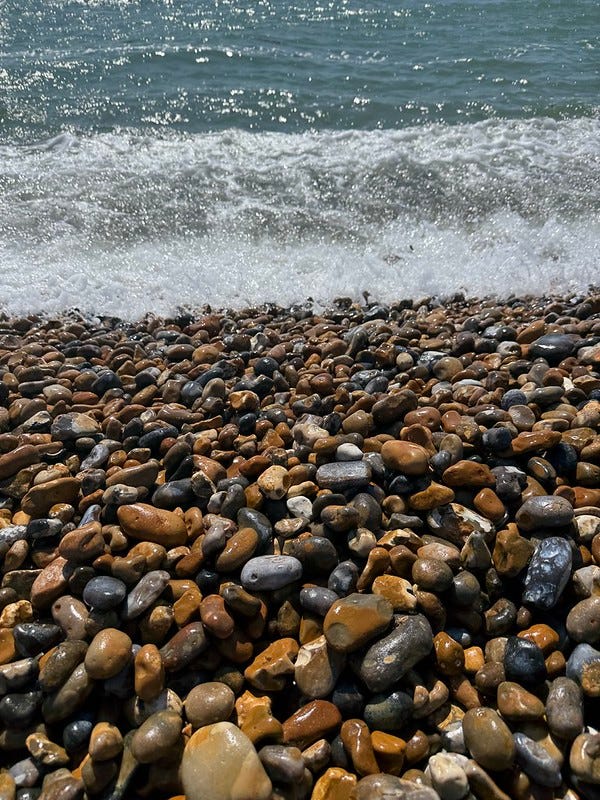
Image: Shingle beach with flint shingle evident - Alan Parkinson
The shingle is almost entirely (over 98%) rounded flint shingle with pebbles of cherry sandstones derived from the Upper Greensand, fine-grained sandstones from the Hastings Beds, and red, grey and liver-coloured quartzites, including examples of the Triassic Budleigh Salterton Pebble Beds. Some of the latter may have been brought here as ballast.
The shingle ridges are known as “fulls” and the low lying areas between them are known as “lows” or “swales”. The heights of the ridges vary between 3.7 m and 6.3 m above sea level.
Research was carried out in this area by several former GA Presidents including J A Steers and W V G Balchin.
The swales can provide some shelter from the persistent wind for low-lying plants.
Human features of interest
Prospect Cottage
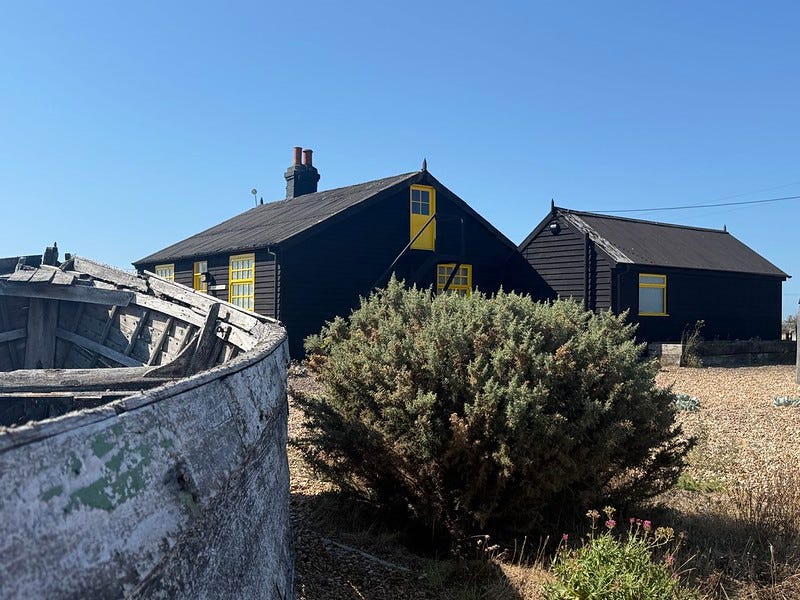
Image: Prospect Cottage - Alan Parkinson
This was the former home of the film director Derek Jarman. He found peace here, moving to Dungeness in 1994, and retreated here after an AIDS diagnosis, and created a garden in the shingle. Planting sits in amongst beach flotsam and jetsam: driftwood and rusted metal.
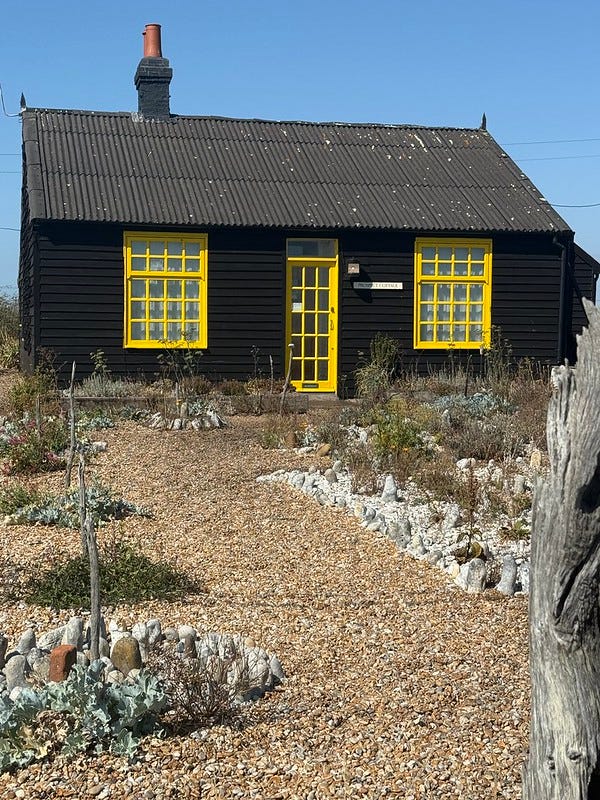
Image: Prospect Cottage - Alan Parkinson
Jarman is buried in nearby Old Romney churchyard, near to a 500+ year old yew tree.
An excellent locally-run pub which serves outstanding fish and chips and their very own Pilot Ale. The car park has a number of interesting artefacts including the propellor from a B17 which crashed off the coast during World War II and was found by a local trawler.
Another pub called The Britannia sits near the Old Lighthouse and railway station.
Opened in 1904 and in operation for over 50 years. Built of sandstone and over 45m tall it offers a grand view of Dungeness. Adult ticket to climb was £5.00 in the summer of 2026, with children £4.00. A small shop sells souvenirs. The last section is a steep ladder, and access to the viewing platform is through a hole in the metal wall.
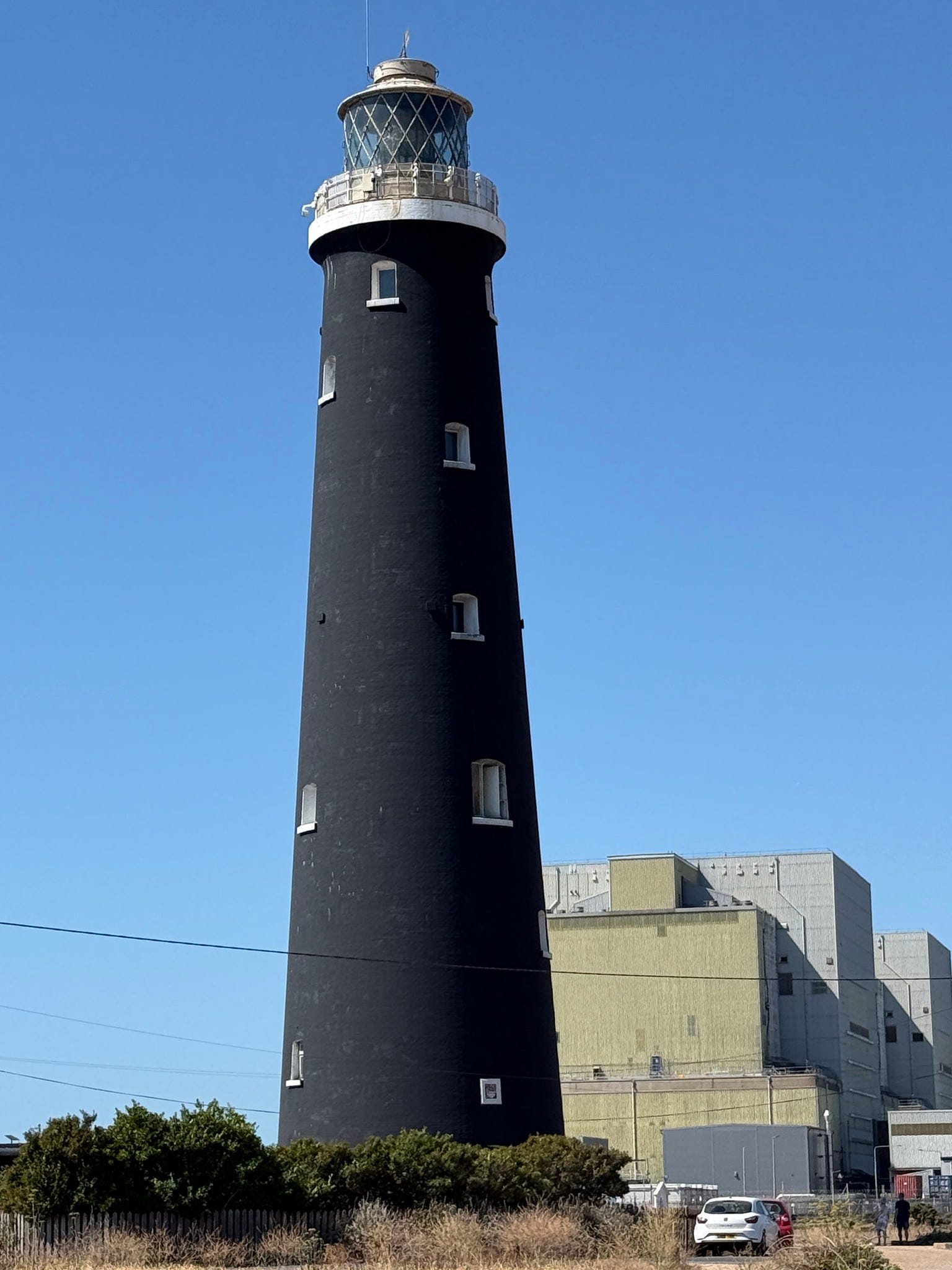
Image: The Old Lighthouse - Alan Parkinson
Next to it is the base of the original lighthouse: a round structure which provided accommodation for the lighthouse keepers.
The New Lighthouse
This stripy tower also houses the fog signal. See image at the start of this Substack post.
Navigation markers
Two structures are erected on the beach – one has a diamond shape and the other a ‘T’, seen to the east of the power station. Fishing boat crews would line the ‘T’ up in the diamond and head straight for home knowing they were on the safest line.
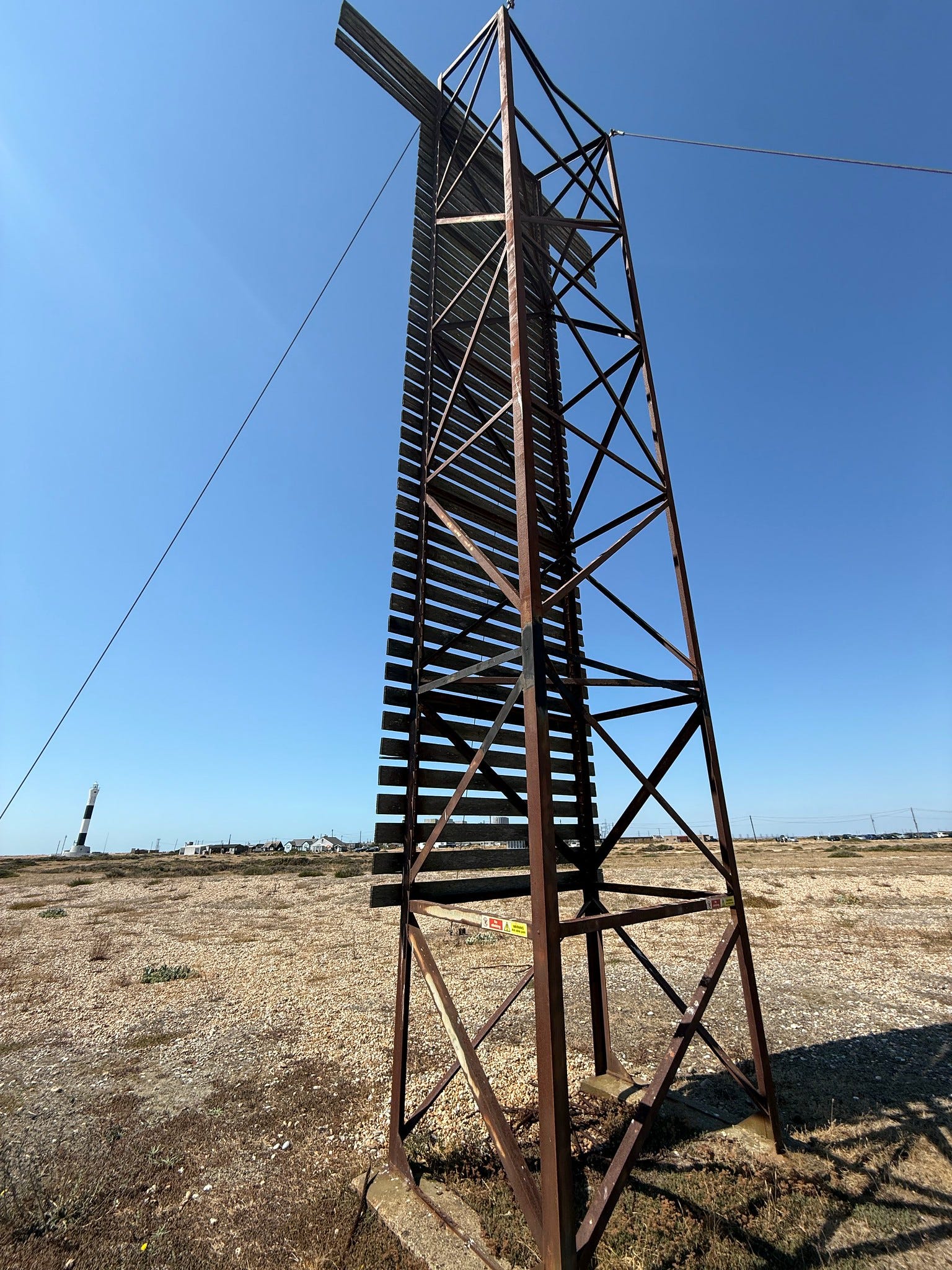
Image: the T-shaped navigation marker - Alan Parkinson
Dungeness is also the ‘end of the line’ for the Romney Hythe & Dymchurch Railway which claims to be the worlds smallest public railway, having a gauge of just 15 inches. The station has the End of the Line restaurant.
Dungeness Nuclear Power Stations
There are two non-operational nuclear power stations on the headland: A and B. These are in the process of being decomissioned.
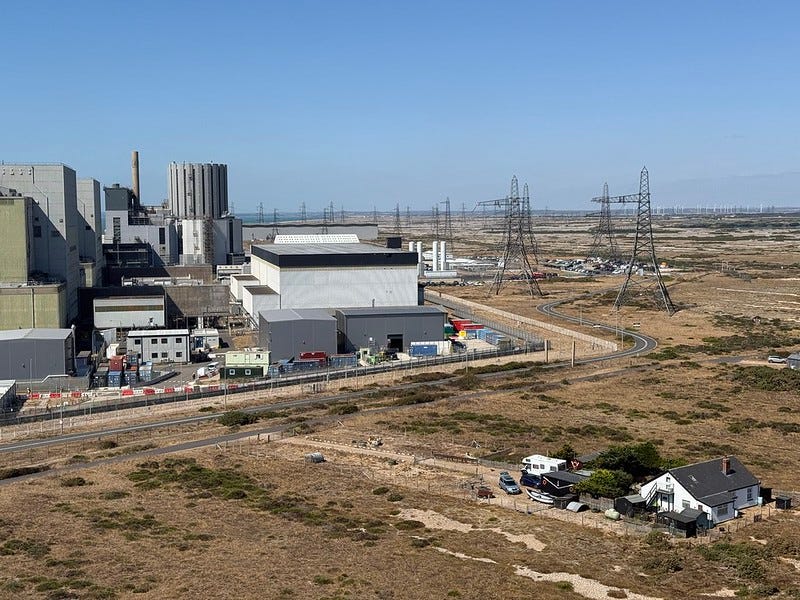
Image: Nuclear Power Station and associated infrastructure - Alan Parkinson
Acoustic Mirrors
The RSPB description of its reserve mentions some wartime structures:
Lade Pits is a unique site for history as well as wildlife, as it contains three Scheduled Ancient Monuments, which are of international significance. The Denge Sound Mirrors (also known as the Acoustic Mirrors or Listening Ears) are three concrete structures which range in size from 20 to 200 feet. They were built between 1928 and 1935 as part of Britain’s national defence strategy. The Sound Mirrors are open to the public during organised events.
Another wartime structure is available as a holiday let.
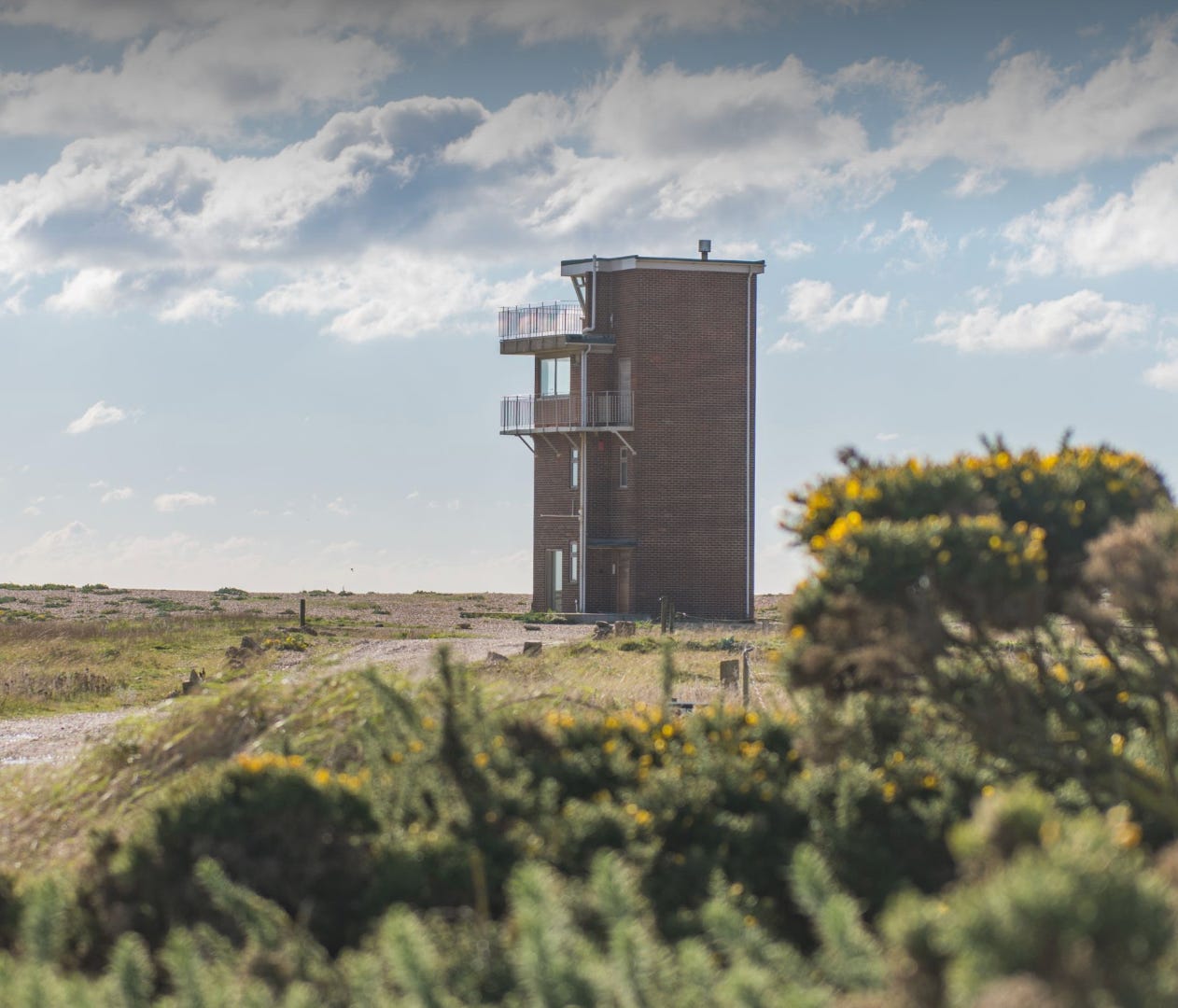
Image: Bloom Stays.
References
Dungeness website: https://dungeness.org.uk/
Wikipedia page: https://en.wikipedia.org/wiki/Dungeness
A Flickr album of images I took on my visit: https://flickr.com/photos/geographypages/albums/72177720335088370/
The Dungeness Estate was put up for sale for £1.5million in 2015.
Some other Substack posts on Dungeness:
Poetry

Photography

Dungeness was primarily a fishing community, with boats launched directly from the beach and pulled back in by hand at the end of a day’s fishing. In the late 1920’s miniature railway tracks were laid from the boats and up the beach to the fisherman’s cottages at the top of the shingle, so that their fishing hauls could be transferred to awaiting transport. These tracks fell into disuse when a road was built in the late 1930’s. At the same time, the old way of dragging the boats ashore by the fisherman’s families was replaced by winches and then engines.
Here is the blog I’ve been creating for several years ready to support the new qualification.
Thanks Alan. A great profile of a fascinating place.